


Mark Tabata’s Daily Devotionals
Friday, November 20 2026
More Bible Studies Available @ http://www.marktabata.com. To Receive Free Bible Studies and updates via email, contact Mark Tabata @ 606-216-1757 (SMS Only) or mailto:markatabata@gmail.com (Email). Follow me on Substack: http://substack.com/@marktabata. Also, please visit my author page: http://amazon.com/author/marktabata


Titus 1:2-in hope of eternal life which God, who cannot lie, promised before time began,
When studying the Quran, one will become immediately aware of the fact that it is not arranged in historical order. The chapters (surahs) are arranged in an order that emphasizes length instead of chronological format. There is debate among Muslim scholars about who decided this order. Some say that Allah instructed Gabriel how to arrange the surahs, who then told Muhammad, who then ordered the arrangement to the Quran. Others believe that Muhammad himself determined this, and still others that the followers of Muhammad arranged the order of the Quran after he died.
One researcher explains the subject well, and also provides a suggested (but at times debated) historical arrangement of the surahs in the Quran.
The Qur’an is just over half the length of the New Testament[ 25] and about one-fifth as long as the Hebrew Scriptures (Old Testament).[ 26] It contains 114 surat,[ 27] roughly equivalent to the concept of a chapter, divided into ayat[ 28] of varying lengths, roughly equivalent to verses. Normally, the surat are named according to something mentioned in their text: for instance, Surah 2, Al-Baqarah (“ The Cow”), Surah 9, Al-Taubah (“ Repentance”), etc.[ 29] According to the traditional story, it was dictated to Muhammad by the angel Gabriel over the course of twenty-two years (610–632).[ 30] The Qur’an’s organization is neither chronological nor topical. In fact, its arrangement seems rather pedestrian: It is roughly ordered by the size of the surat. Surah 1, Al-Fatihah, is little more than the seven-ayah opening prayer (as well known to Muslims as the so-called Lord’s Prayer is to Christians), but Surah 2 contains a whopping 286 ayat, and Surah 3, the next in line, 200. This has created a stumbling block to many a Western reader making an initial attempt at understanding the Islamic holy book. If you started “at the beginning” and read on to the end, you would be jumping back and forth between periods of Muhammad’s life, and in this way, obtaining a meaningful background and context is next to impossible. Not only were the surat written at different times (with different settings and historical referents), but Islamic sources also seem to indicate that even a single given surah may cobble together materials from widely divergent periods into one text. The non-expert reader often is without help, within the text itself, in determining a subject’s background or how one subject may relate to another. So over the centuries, an elaborate system of external commentary developed, known as tafsir, that is dependent upon Muhammad’s collected sayings and actions, known as the hadith.[ 31] These collections have become the normative lens through which the Qur’an is interpreted. For the reader who endeavors to read the Qur’an with maximized understanding, the following chart, based upon the work of many others,[ 32] provides what I can only call a broadly chronological order of the surat. That is, its order generally presents the Islamic holy book’s content according to linear or historical progress. Combine that with some of the editions of the Qur’an that do provide some historical background and you have perhaps the best possibility for reading it in the fairest and most accurate way.[ 33]. (James R. White, What Every Christian Needs to Know About the Qur’an, 44-45 (Kindle Edition): Bloomington, Minnesota: Bethany House Publishers)
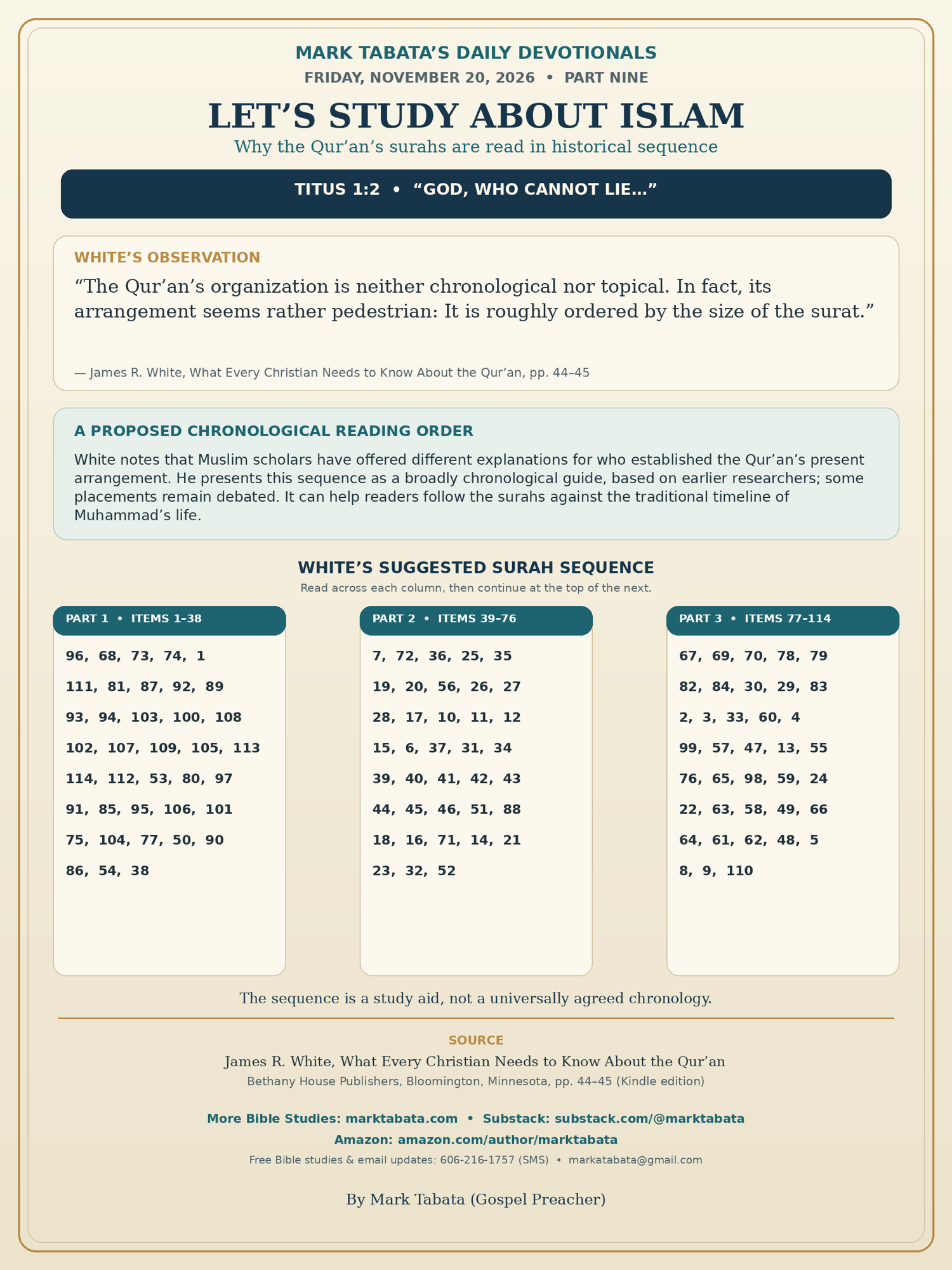
White suggests that the different surahs, if arranged from a chronological point of view, should be read in this order: 96, 68, 73, 74, 1, 111, 81, 87, 92, 89, 93, 94, 103, 100, 108, 102, 107, 109, 105, 113, 114, 112, 53, 80, 97, 91, 85, 95, 106, 101, 75, 104, 77, 50, 90, 86, 54, 38, 7, 72, 36, 25, 35, 19, 20, 56, 26, 27, 28, 17, 10, 11, 12, 15, 6, 37, 31, 34, 39, 40, 41, 42, 43, 44, 45, 46, 51, 88, 18, 16, 71, 14, 21, 23, 32, 52, 67, 69, 70, 78, 79, 82, 84, 30, 29, 83, 2, 3, 33, 60, 4, 99, 57, 47, 13, 55, 76, 65, 98, 59, 24, 22, 63, 58, 49, 66, 64, 61, 62, 48, 5, 8, 9, 110.
Since the surahs in the Quran are in such disarray from a historical point of view, the Hadith are very important in trying to understand the events and teachings of this book. This order will help us to better understand the Quran as we continue our studies of Islam and the life of Muhammad.
The grace of the Lord Jesus Christ, and the love of God, and the communion of the Holy Spirit, be with you all. Amen.