


Wednesday, November 18 2026
More Bible Studies Available @ http://www.marktabata.com. To Receive Free Bible Studies and updates via email, contact Mark Tabata @ 606-216-1757 (SMS Only) or mailto:markatabata@gmail.com (Email). Follow me on Substack: http://substack.com/@marktabata. Also, please visit my author page: http://amazon.com/author/marktabata


1 Peter 1:25-BUT THE WORD OF THE LORD ENDURES FOREVER.” Now this is the word which by the gospel was preached to you.
We have been investigated the charge from our Muslim neighbors that the early Christians corrupted the New Testament. So far, here is what we have learned.
The early Christians could not have corrupted the New Testament even if they had wanted to. There were many eyewitnesses who would have quickly called the church out if that been attempted, and the sheer number and distribution of the New Testament would make such impossible.
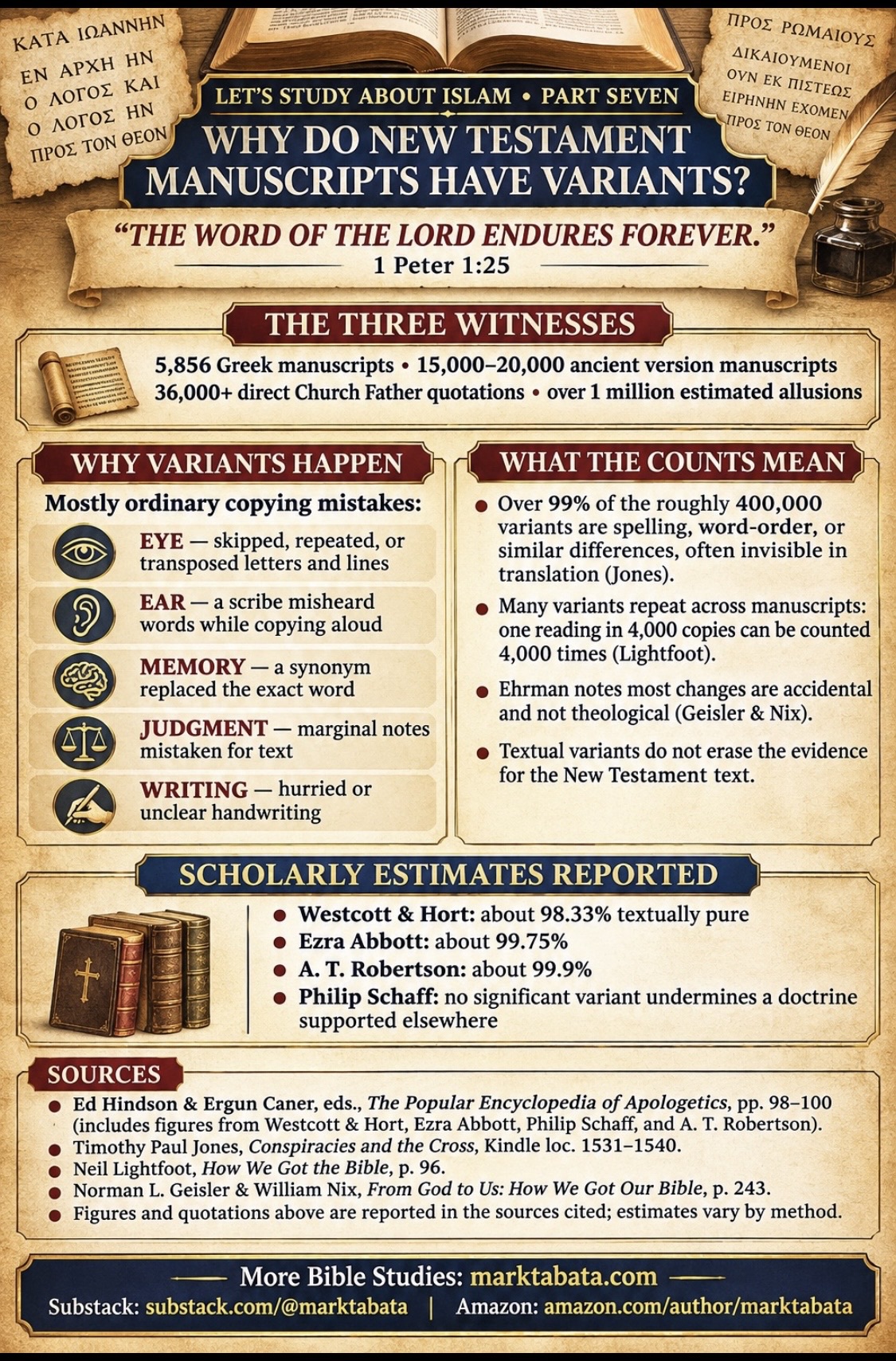
The existence of textual variants stems from the existence and number of the three sources of our New Testament: the Greek manuscript copies of the original Apostolic writings (5, 856 copies); the translations of these manuscript copies into other languages (the “versions,” of which we have been 15, 000-20, 000 copies); and the quotations of the early church fathers of the New Testament (over 36, 000 direct quotations and over a million allusions).
These manuscripts are in over 86% agreement.
Now sometimes, when you compare those many manuscripts, they may have slight differences at certain places. One might say one thing at a particular verse, and another manuscript of the same passage says something slightly different. This is known as a textual variant.
This is where we will begin our study today.
Why do these textual variants exist?
There are actually many reasons, which make perfect sense when one considers the matter.
Unintentional changes of various kinds all arise from the imperfection of some human faculty. These constitute by far the vast majority of all transcriptional errors. 1. Errors of the eye • Wrong division of words that resulted in the formation of new words—early manuscripts were not punctuated, and letters were not separated into words by spaces. • Omission of letters, words, and even whole lines occurred when the astigmatic eye mistook one group of letters or words for another, sometimes located on a different line. • Repetition results in an error opposite the error of omission. Hence, when the eye picked up the same letter or word twice and repeated it, it is called dittography. • Transposition is the reversal of the position of two letters or words. This is technically known as metathesis. In 2 Chronicles 3:4, the transposition of a letter would make the measurements of the porch of Solomon’s Temple out of proportion—for example, 120 cubits instead of 20 cubits as in the LXX (Septuagint). • Other confusion of spelling abbreviations or scribal insertions account for the remainder of scribal errors. This is especially true about Hebrew letters, which were also used for numbers and could be easily confused. These errors of the eye may account for many of the numerical discrepancies in the Old Testament (cf. 2 Kings 8:26; 2 Chronicles 22:2). 2. Errors of the ear occurred only when manuscripts were copied while listening to someone read them. This may explain why some manuscripts (fifth century onward) read kamelos (a rope) instead of kamēlos (a camel) in Matthew 19:24. In 1 Corinthians 13:3, kauthēsomai (he burns) was confused with kauchēsomai (he boasts). 3. Errors of memory. These are not so numerous, but occasionally a scribe might forget the precise word in a passage and substitute a synonym. 4. Errors of judgment. The most common error of this kind is caused by dim lighting or poor eyesight. Sometimes marginal notes were incorporated into the text under the misapprehension that they were part of the text. It is difficult to determine whether some variants are caused by faulty judgment or intentional doctrinal changes….5. Errors of writing. If a scribe, due to imperfect style or accident, wrote indistinctly or imprecisely, he would set the stage for future error of sight or judgment. Rapid copying was no doubt responsible for many errors in writing. This is viewed especially in the parallel accounts of the Kings-Chronicles corpus. (Ed Hindson & Ergun Caner, The Popular Encyclopedia Of Apologetics, 98-99 (Kindle Edition); Eugenee Oregon; Harvest House Publishers)
Our Muslim neighbors may object, “There are hundreds of thousands of these variants in the New Testament manuscript!”
That’s true enough.
Now, what do over 99 % of these hundreds of thousands of errors amount to?
The overwhelming majority of these four hundred thousand supposed variations stem from differences in spelling, word order, or the relationships between nouns and definite articles. In other words, a copyist simply switched a couple of letters, misheard a word, or skipped a line of text. Such variants are readily recognizable and, in most cases, utterly unnoticeable in translations!…In the end, more than 99 percent of the four hundred thousand or so differences fall into this category of variants that can’t even be seen in translations! (Timothy Paul Jones, Conspiracies And The Cross, 1531-1540 (Kindle Edition); Lake Mary, Florida; FrontLine)
That’s right: most of these textual variants are nothing more then misspelled words, a letter that was copied twice, a line of text that was accidentally overlooked, etc. Thanks to the number of manuscripts we have, they do not pose any problem to preserving the original text, since all a person has to do is compare the manuscripts together and the variants are quickly seen!
What’s more, the reason why there is such a large number of these variants is due to the way that they are counted. A misspelled word in one manuscript that is then copied 200, 000 times is thereby counted as 200, 000 “errors,” even though it is just one misspelled word!
This large number is gained by counting all the variations in all of the manuscripts (above 5,300). For example, if one slight variant were to occur in 4,000 different manuscripts, this would amount to 4,000 “errors.” But this is how one can arrive at the large number of 200,000 “errors.” A person is either unlearned or of a skeptical mind who tries to take this large number of variations and use it in such a way as to undermine one’s faith in the Word of God. (Neil Lightfoot, How We Got The Bible, 96 (Kindle Edition); Grand Rapids, Michigan; Baker Books)
Now, let’s take this knowledge and apply it to one modern day critic of the New Testament, Bart Ehrman.
Ironically, the way Ehrman counts “errors” (variants), there were 1.6 million errors in the first printing of his book. For there were 16 errors, and the book printed an alleged 100,000 copies.6 Yet Ehrman would be shocked if someone denied the credibility of his book based on this count. Similarly, no one should deny the credibility of the Bible on Ehrman’s count. Ehrman himself admits the biblical variants do not affect the central message of the Bible. He wrote, “In fact, most of the changes found in early Christian manuscripts have nothing to do with theology or ideology. Far and away the most changes are the result of mistakes pure and simple—slips of the pen, accidental omissions, inadvertent additions, misspelled words, blunders of one sort or another. (Norman L. Geisler & William Nix, From God To Us: How We Got Our Bible, 243 (Kindle Edition); Chicago; Moody Publishers)
Do these textual variants in any way take away from the credibility of the New Testament text?
Not in the least.
4. How significant are the variants? It is easy to leave the wrong impression by speaking of 200,000 “errors” that have crept into the text due to scribal mistakes and intended corrections. There are only 10,000 places where these 200,000 variants occur. The next question is, How significant are those 10,000 places? Textual critics have attempted to answer that question by offering percentages and comparisons. a. Scholars Westcott and Hort estimated that only about one-eighth of all the variants had any weight, as most of them merely involve mechanical matters such as spelling or style. Of the whole, then, only about one-sixtieth rise above “trivialities,” or can in any sense be called substantial variations. Mathematically that would compute to a text that is 98.33 percent pure whether the critic adopts the Textus Receptus, Majority Nestle-Aland Text, or some eclectic text of the New Testament. b. Ezra Abbott gave similar figures, saying about 19/20 (95 percent) of the readings are various rather than rival readings, and about 19/20 (95 percent) of the remainder are of so little importance that their addition or rejection makes no appreciable difference in the sense of the passage. Thus the degree of substantial purity would be 99.75 percent. c. Philip Schaff (p. 177) surmised that of the 150,000 variations known in his day, only 400 affected the sense; and of those, only 50 were of real significance; and of this total, not one affected “an article of faith or a precept of duty which is not abundantly sustained by other undoubted passages, or by the whole tenor of Scripture teaching.” d. A.T. Robertson (p. 22) suggested that the real concern of textual criticism is of a “thousandth part of the entire text That would make the reconstructed text of the New Testament 99.9 percent free from real concern for the textual critic. (Ed Hindson & Ergun Caner (General Editors), The Popular Encyclopedia Of Apologetics: Surveying The Evidence For The Truth Of Christianity, 99-100 (Kindle Edition); Eugene, Oregon; Harvest House Publishers)
The Islamic claim that the New Testament was corrupted simply is not true. The vast number of manuscripts, the agreement between, and the existence and type of textual variants between them, actually provides incredible corroboration of the preservation of the Word of God.
Father, thank You for preserving Your Word as You promised. Strengthen us with this knowledge and help us to reach out to our friends and neighbors to show them the truth and logic of the Scriptures. Amen.