


Mark Tabata’s Weekday Devotionals
Monday, October 5
More Bible Studies Available @ http://www.marktabata.com. To Receive Free Bible Studies and updates via email, contact Mark Tabata @ 606-216-1757 (SMS Only) or mailto:markatabata@gmail.com (Email). Follow me on Substack: http://substack.com/@marktabata. Also, please visit my author page: http://amazon.com/author/marktabata


Luke 8:11-15-Now the parable is this: The seed is the word of God. 12 Those by the wayside are the ones who hear; then the devil comes and takes away the word out of their hearts, lest they should believe and be saved. 13 But the ones on the rock are those who, when they hear, receive the word with joy; and these have no root, who believe for a while and in time of temptation fall away. 14 Now the ones that fell among thorns are those who, when they have heard, go out and are choked with cares, riches, and pleasures of life, and bring no fruit to maturity. 15 But the ones that fell on the good ground are those who, having heard the word with a noble and good heart, keep it and bear fruit with patience.
Over many years of ministry, I have worked with lots individuals who disbelieved in the Bible. Quite often, this initial distrust of God’s Word was based on the mistaken notion that the Bible has been proven false time after time. Indeed, many believed that “real scholars” had long since demonstrated that the Bible is a collection of myths and fables. When such claims are made, I like to share with them these (or similar) words from scholar Craig Blomberg.
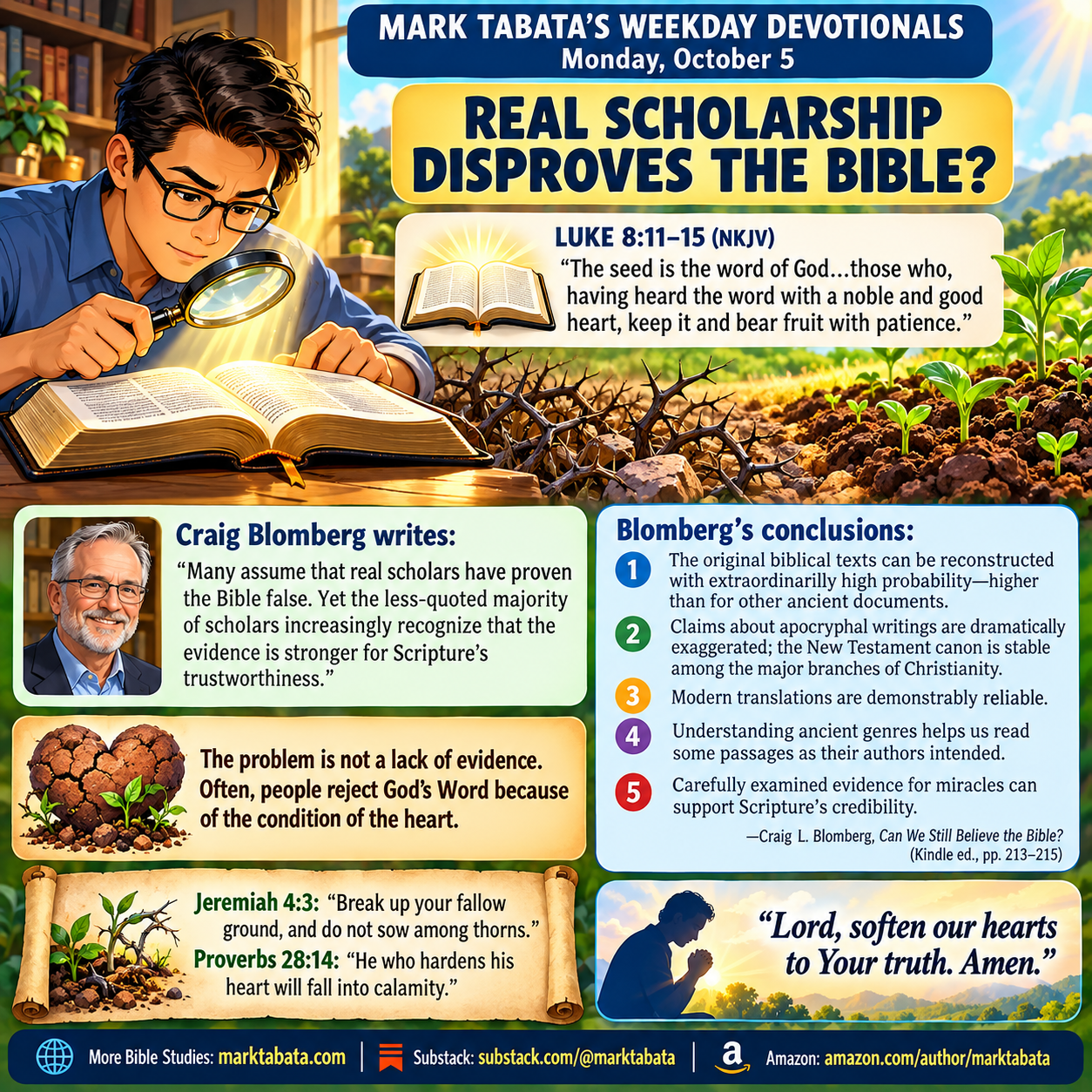
Ironically, what has become best known in our culture over the past generation, both inside and outside of Christian circles, is the flurry of skepticism that certain narrow segments of scholarship and pseudoscholarship have unleashed. This is ironic because in each instance the less-quoted majority of scholars2 have increasingly come to recognize that the evidence is actually stronger for the trustworthiness of Scripture in each of these areas, as long as that trustworthiness is appropriately defined by the standards of antiquity. Sadly, some of Christianity’s very conservative, high-profile power brokers have played directly into the hands of the most skeptical wing of scholarship by giving the skeptics more attention than they deserve and by branding almost all scholars who reject their own ultraconservatism as just as “liberal” as the archskeptics! Worse still, some people are discouraged from holding the faith altogether, buying into the misconception that they cannot be true Christians at all unless they hold these ultraconservative viewpoints. We have thus discussed the charges that the textual transmission of the biblical books was so corrupt that we cannot even be sure how close to the original documents our current Bible is. We have examined claims that the biblical canon is up for grabs, that the only or main reason we have the sixty-six books that all branches of Christendom agree on is because the early church leaders, who decreed which documents should be treated as uniquely sacred, were the victors in battles with others who wanted to create a very different Bible. We have looked at allegations that the proliferation of modern-language translations, especially in English, suggests that we really don’t have the ability to declare any given translation sufficiently reliable for Christian thought and life. The true state of affairs in each of these areas is quite the opposite: (1) We have an extraordinarily high probability of being able to reconstruct the original texts of the biblical books, much higher than for any other documents of antiquity. (2) Especially with respect to the New Testament books, where there is no disagreement among the major branches of the Christian church as to what the canon should contain, claims about the accuracy and value of apocryphal or noncanonical counterparts are dramatically exaggerated. (3) Modern-language translations, including in English, are demonstrably very reliable. In addition, we have scrutinized the historic Christian doctrine of the inerrancy of Scripture to see what it does and does not claim about the uniquely trustworthy nature of the Bible. We observed that it does not require us to hold the ancient texts to any higher standards of accuracy than would have been imposed by the societies from which they emerged. To do otherwise is sheer anachronism. We considered a sampling of some of the most well-known illustrations of biblical books or passages where Christians without access to comparative literature from the ancient world may have too often taken a text to be historical that was never intended to be so taken. In other words, defending Scripture’s reliability in these instances might require our recognition of a different genre of prose narrative rather than straightforward history. The results, in turn, may make inerrancy even more defensible than it was previously. Finally, we turned to the issue of the miraculous. While for many this is the ultimate defeater in taking the Bible seriously, the amount of documented evidence for miracles similar to those of the Bible, especially from the last century or so, is so overwhelming that it actually counts as strong evidence for the credibility of Scripture. If someone seriously and dispassionately examines this evidence and still rejects it in toto, it is hard not to conclude that the prejudice at work is just irrational. This does not mean that we accept all claims of the miraculous in our world or in previous eras; indeed, we should want to employ very strict criteria before ever accepting them in any context. But when those criteria are fully met, to then continue to claim that there must be a naturalistic or scientific explanation that we just haven’t discovered yet constitutes a faith claim with less rational foundation than the faith that believers must exercise to be Christians! These are among the most important reasons that I believe in the uniquely God-given nature of the Bible more than ever after forty-three years of being a Christian and after forty-two years of studying it from just about every perspective ever invented! (Craig L. Blomberg, Can We Still Believe the Bible?: An Evangelical Engagement with Contemporary Questions, 213-215 (Kindle Edition): Grand Rapids, MI: Brazos Press)
The problem is not a lack of evidence, nor is it often a person’s lack of knowledge of such evidence.
People often reject the Word of God because of the condition of their heart.
Jeremiah 4:3-For thus says the LORD to the men of Judah and Jerusalem: “Break up your fallow ground, And do not sow among thorns.
Proverbs 28:14-Happy is the man who is always reverent, But he who hardens his heart will fall into calamity.
Lord, soften our hearts to Your truth. Amen.