


Mark Tabata’s Weekday Devotionals
Wednesday August 5 2026
More Bible Studies Available @ http://www.marktabata.com. To Receive
Free Bible Studies And Updates Via Email, Contact Mark Tabata @ 606-216-1757 (SMS Only) or mailto:markatabata@gmail.com (Email). Follow me on Substack: http://substack.com/@marktabata. Also please visit my author page: http://amazon.com/author/marktabata


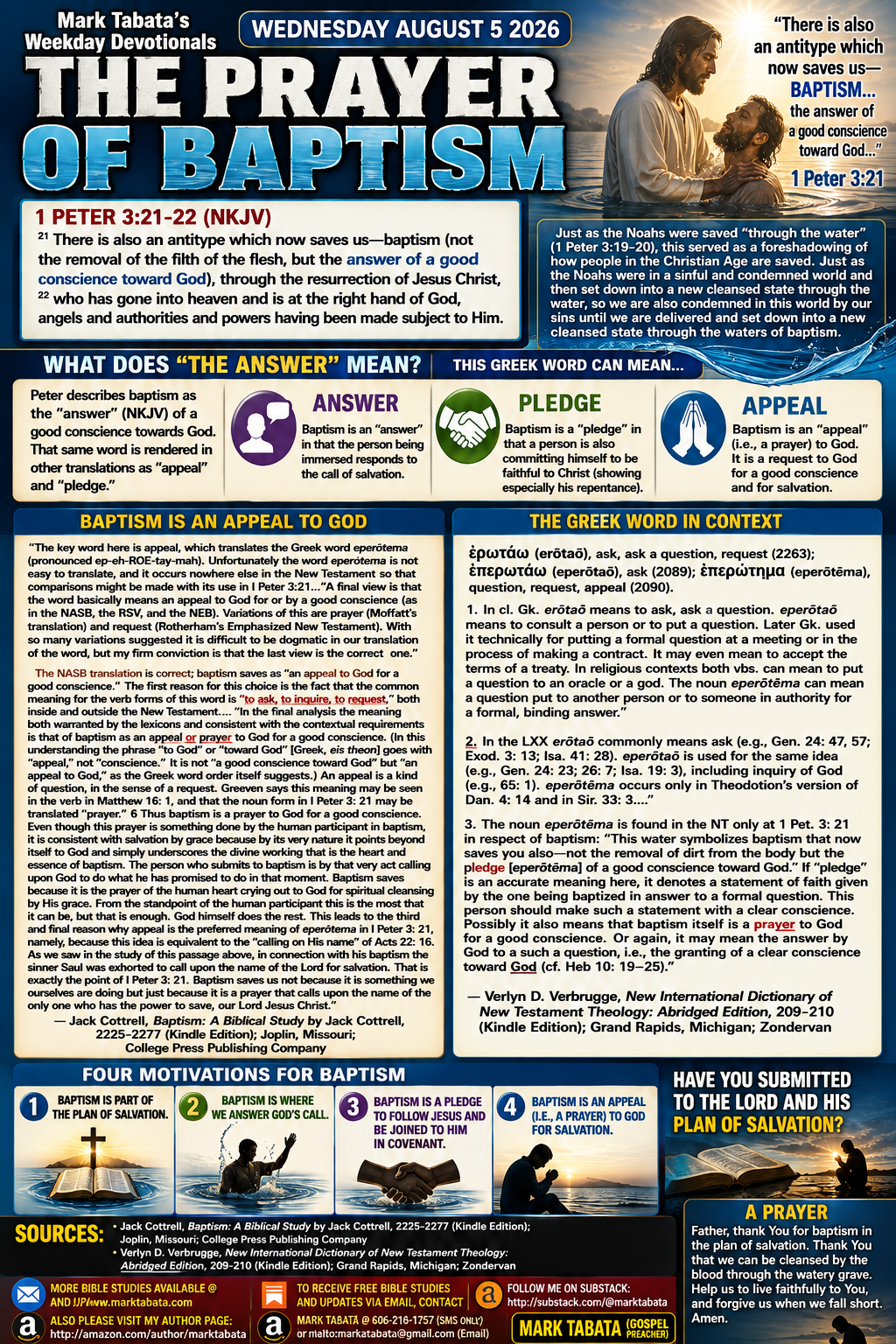
1 Peter 3:21-22-There is also an antitype which now saves us—baptism (not the removal of the filth of the flesh, but the answer of a good conscience toward God), through the resurrection of Jesus Christ, 22 who has gone into heaven and is at the right hand of God, angels and authorities and powers having been made subject to Him.
The Bible here emphatically declares that baptism saves us, i.e., it is part of God’s plan of man’s salvation. Just as the Noahs were saved “through the water” (1 Peter 3:19-20), this served as a foreshadowing of how people in the Christian Age are saved. Just as the Noahs were in a sinful and condemned world and then set down into a new cleansed state through the water, so we are also condemned in this world by our sins until we are delivered and set down into a new cleansed state through the waters of baptism.
What is fascinating is that Peter describes baptism as the “answer” (NKJV) of a good conscience towards God. That same word is rendered in other translations as “appeal” and “pledge.” The reason why you have these different translations is simple. It is because this particular Greek word can be rendered in all of these ways!
So baptism is an “answer” in that the person being immersed responds to the call of salvation. Baptism is a “pledge” in that a person is also committing himself to be faithful to Christ (showing especially his repentance).
But think with me about that final rendering: baptism is an “appeal” to God.
Some years ago, brother Jack Cottrell wrote a fascinating study on baptism. In it, he provides this beautiful exposition of this word.
The key word here is appeal, which translates the Greek word eperotema (pronounced ep-eh-ROE-tay-mah). Unfortunately the word eperotema is not easy to translate, and it occurs nowhere else in the New Testament so that comparisons might be made with its use in I Peter 3:21…“A final view is that the word basically means an appeal to God for or by a good conscience (as in the NASB, the RSV, and the NEB). Variations of this are prayer (Moffatt’s translation) and request (Rotherham’s Emphasized New Testament). With so many variations suggested it is difficult to be dogmatic in our translation of the word, but my firm conviction is that the last view is the correct one. The NASB translation is correct; baptism saves as “an appeal to God for a good conscience.” The first reason for this choice is the fact that the common meaning for the verb forms of this word is “to ask, to inquire, to request,” both inside and outside the New Testament….“In the final analysis the meaning both warranted by the lexicons and consistent with the contextual requirements is that of baptism as an appeal or prayer to God for a good conscience. (In this understanding the phrase “to God” or “toward God” [Greek, eis theon] goes with “appeal,” not “conscience.” It is not “a good conscience toward God” but “an appeal to God,” as the Greek word order itself suggests.) An appeal is a kind of question, in the sense of a request. Greeven says this meaning may be seen in the verb in Matthew 16: 1, and that the noun form in I Peter 3: 21 may be translated “prayer.” 6 Thus baptism is a prayer to God for a good conscience. Even though this prayer is something done by the human participant in baptism, it is consistent with salvation by grace because by its very nature it points beyond itself to God and simply underscores the divine working that is the heart and essence of baptism. The person who submits to baptism is by that very act calling upon God to do what he has promised to do in that moment. Baptism saves because it is the prayer of the human heart crying out to God for spiritual cleansing by His grace. From the standpoint of the human participant this is the most that it can be, but that is enough. God himself does the rest. This leads to the third and final reason why appeal is the preferred meaning of eperotema in I Peter 3: 21, namely, because this idea is equivalent to the “calling on His name” of Acts 22: 16. As we saw in the study of this passage above, in connection with his baptism the sinner Saul was exhorted to call upon the name of the Lord for salvation. That is exactly the point of I Peter 3: 21. Baptism saves us not because it is something we ourselves are doing but just because it is a prayer that calls upon the name of the only one who has the power to save, our Lord Jesus Christ. (Jack Cottrell, Baptism: A Biblical Study by Jack Cottrell, 2225-2277 (Kindle Edition); Joplin, Missouri; College Press Publishing Company)
Another excellent study especially draws attention to this word in the Greek Old Testament.
ἐρωτάω (erōtaō), ask, ask a question, request (2263); ἐπερωτάω (eperōtaō), ask (2089); ἐπερώτημα (eperōtēma), question, request, appeal (2090). CL & OT 1. In cl. Gk. erōtaō means to ask, ask a question. eperōtaō means to consult a person or to put a question. Later Gk. used it technically for putting a formal question at a meeting or in the process of making a contract. It may even mean to accept the terms of a treaty. In religious contexts both vbs. can mean to put a question to an oracle or a god. The noun eperōtēma can mean a question put to another person or to someone in authority for a formal, binding answer. 2. In the LXX erōtaō commonly means ask (e.g., Gen. 24: 47, 57; Exod. 3: 13; Isa. 41: 28). eperōtaō is used for the same idea (e.g., Gen. 24: 23; 26: 7; Isa. 19: 3), including inquiry of God (e.g., 65: 1). eperōtēma occurs only in Theodotion’s version of Dan. 4: 14 and in Sir. 33: 3….“3. The noun eperōtēma is found in the NT only at 1 Pet. 3: 21 in respect of baptism: “This water symbolizes baptism that now saves you also—not the removal of dirt from the body but the pledge [eperōtēma] of a good conscience toward God.” If “pledge” is an accurate meaning here, it denotes a statement of faith given by the one being baptized in answer to a formal question. This person should make such a statement with a clear conscience. Possibly it also means that baptism itself is a prayer to God for a good conscience. Or again, it may mean the answer by God to a such a question, i.e., the granting of a clear conscience toward God (cf. Heb 10: 19–25). (Verlyn D. Verbrugge, New International Dictionary of New Testament Theology: Abridged Edition, 209-210 (Kindle Edition); Grand Rapids, Michigan; Zondervan)
The Bible here teaches us four motivations for baptism.
First, baptism is part of the plan of salvation.
Second, baptism is where we answer God’s call.
Third, baptism is a pledge to follow Jesus and be joined to Him in covenant.
Fourth, baptism is an appeal (i.e., a prayer) to God for salvation.
Have you submitted to the Lord and His plan of salvation?
Father, thank You for baptism in the plan of salvation. Thank You that we can be cleansed by the blood through the watery grave. Help us to live faithfully to You, and forgive us when we fall short. Amen.