


Mark Tabata’s Weekday Devotionals
Friday July 3 2026
More Bible Studies Available @ http://www.marktabata.com. To Receive
Free Bible Studies And Updates Via Email, Contact Mark Tabata @ 606-216-1757 (SMS Only) or mailto:markatabata@gmail.com (Email). Follow me on Substack: http://substack.com/@marktabata. Also please visit my author page: http://amazon.com/author/marktabata


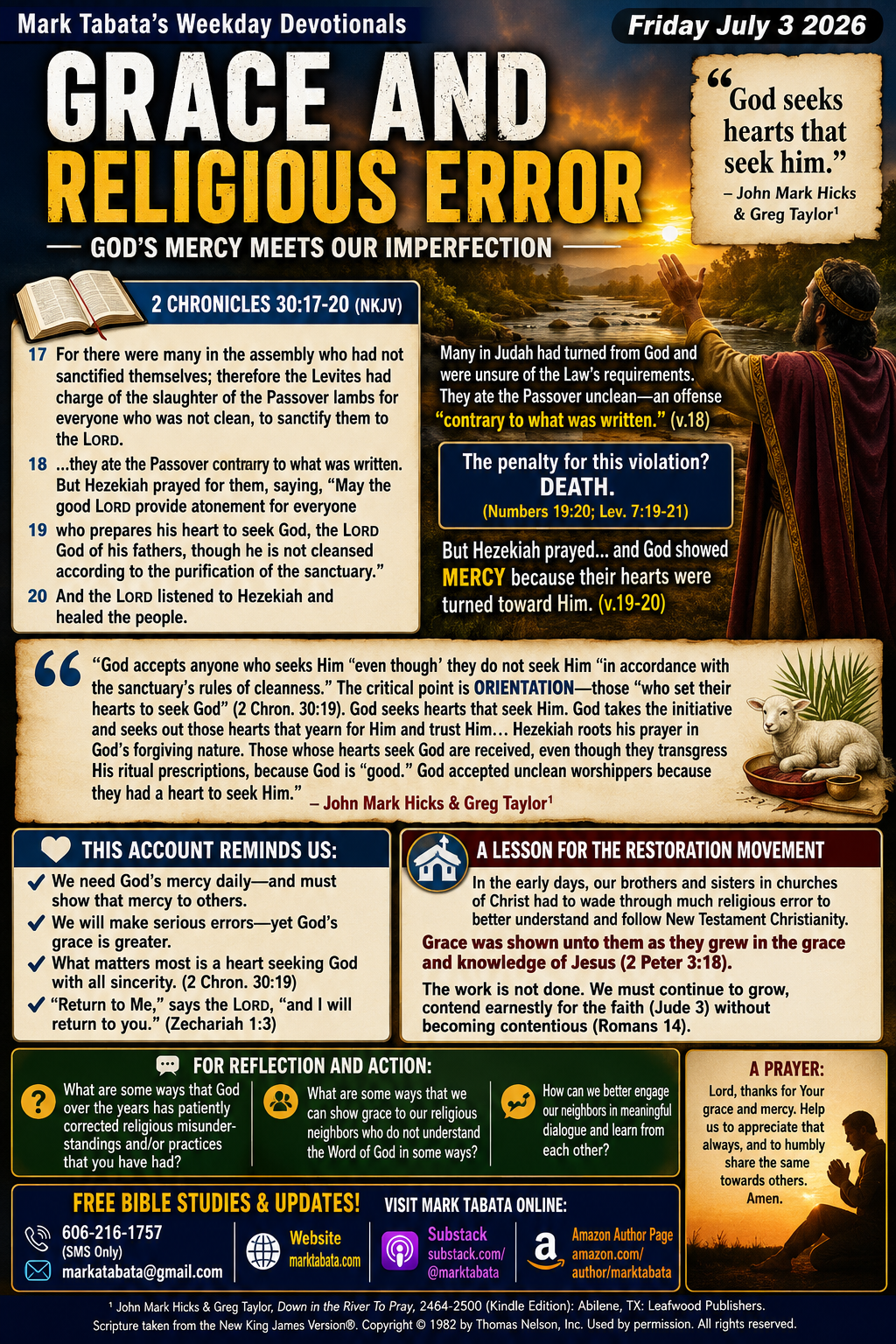
2 Chronicles 30:17-20-For there were many in the assembly who had not sanctified themselves; therefore the Levites had charge of the slaughter of the Passover lambs for everyone who was not clean, to sanctify them to the LORD. 18 For a multitude of the people, many from Ephraim, Manasseh, Issachar, and Zebulun, had not cleansed themselves, yet they ate the Passover contrary to what was written. But Hezekiah prayed for them, saying, “May the good LORD provide atonement for everyone. 19 who prepares his heart to seek God, the LORD God of his fathers, though he is not cleansed according to the purification of the sanctuary.” 20 And the LORD listened to Hezekiah and healed the people.
Throughout time, there have been many occasions when people have turned from God and departed from His Word. The Book of Judges contains many examples of this. The people would often depart from God, and then (after difficult times) repent and return to His Word. Through the years, God’s message was the same: return to Him, and He would return to His people.
Zechariah 1:3-Therefore say to them, ‘Thus says the LORD of hosts: “Return to Me,” says the LORD of hosts, “and I will return to you,” says the LORD of hosts.
During the days of king Hezekiah, many of the people had likewise turned away from God. Then under Hezekiah’s reign, many of them came back to the Lord and kept the Passover. They did this, even though they had not prepared themselves properly. Because the people had not obeyed the Law in such a long time, they were unaware of all the ritual preparations that had to be performed before they could take the Passover acceptably. This amounted to very serious violations under the Old Covenant.
Numbers 19:20-But the man who is unclean and does not purify himself, that person shall be cut off from among the assembly, because he has defiled the sanctuary of the LORD. The water of purification has not been sprinkled on him; he is unclean.
Hezekiah prayed for the people, however, and God accepted and forgave them.
This account reminds us of our continual need for God’s mercy, and for our need to show that mercy to others as well. Here the people of God made some very egregious errors-some that were even worthy of death. They should have known better….yet they didn’t. They were imperfect, and flawed, and they therefore got a lot of important things wrong.
Despite this, God showed them mercy.
They were seeking Him with all their heart and were growing in their understanding of His will.
And that is what makes all the difference.
When Hezekiah began his reign as King of Judah, the temple had been closed for several years (2 Chron. 29: 7). When the temple was cleansed, Hezekiah invited “all Israel and Judah” to celebrate the Passover at the newly rededicated temple (2 Chron. 30: 1). 7 However, Hezekiah celebrated the Passover in the wrong month. Though the Law prescribed the first month, Hezekiah celebrated it in the “second month” (2 Chron. 30: 2). While many think Hezekiah is following the “Second Passover” law of Numbers 9: 2-14 which permits those who are unclean at the time of the first month to celebrate the Passover in the second month once they are clean, the text of Chronicles does not explain the rationale in this light. Hezekiah recognizes that his plan is irregular but he justifies it because “priests had not sanctified themselves in sufficient number” for the celebration in the first month and the people were not yet “assembled in Jerusalem” (2 Chron. 30: 3). Chronicles’ rationale for the irregularity does not invoke Numbers 9 and the rationale includes more than Numbers 9 permits. Numbers 9 permits a second Passover but it does not permit a wholesale abrogation of the first. Thus, grace took precedence over prescribed dates. But may unclean people eat the Passover? Unclean people ate what was clean. This was a clear violation of the Law. Chronicles clearly states that they “ate the Passover contrary to what was written” (2 Chron. 30: 18, NIV). Some have invoked Numbers 9 as a specific authorization for this irregularity, but it does not address this situation. The presumption of Numbers 9 is that those who eat a “second Passover” will be clean when they eat it. Numbers 9 does not authorize unclean people to eat the Passover. Hezekiah’s celebration not only violates Numbers 9, but also Leviticus 7: 19-21 regarding sacrificial meals. The penalty for such a violation was death. But Hezekiah prays for the people. The prayer appeals to the gracious promise of God in 2 Chronicles 6-7 (especially 7: 14). God accepts anyone who seeks him “even though” they do not seek him “in accordance with the sanctuary’s rules of cleanness.” The critical point is orientation—those “who set their hearts to seek God” (2 Chron. 30: 19). This phrase combines two important words in Chronicles: “heart” and “seeking.” The two terms are linked in 1 Chronicles 16: 10; 22: 19; 28: 9; 2 Chronicles 11: 16; 12: 14; 15: 12,15; 19: 3; 22: 9; 30: 19 and 31: 21. “Seek” (translating two Hebrew synonyms) appears fifty-four times in Chronicles and “heart” (translating two Hebrew synonyms) appears sixty-four times. God seeks hearts that seek him. God takes the initiative and seeks out those hearts that yearn for him and trust him (cf. Heb. 11: 6; Matt. 6: 33; John 4: 23-24). Hezekiah prays for the forgiveness of those who violated the divine ritual out of a heart that sought God. The guiding principles of the prayer are two: (1) the goodness of God who seeks a people for himself (1 Chron. 28: 9; 29: 14-17) and (2) the orientation of the heart toward God. Hezekiah roots his prayer in God’s forgiving nature. Those whose hearts seek God are received, even though they transgress his ritual prescriptions, because God is “good.” God accepted unclean worshippers because they had a heart to seek him. The text explicitly records, as if to emphasize the legitimacy of Hezekiah’s request, that “the Lord heard Hezekiah and healed the people” (the promise of 2 Chron. 7: 14). Significantly, Chronicles commends Hezekiah’s Passover renewal in 2 Chronicles 31: 21: “every work that he undertook… to seek his God, he did with all his heart.” Even though he admitted ritually unclean people to the Passover, his Passover is described as wholehearted because he sought God in everything. Why would Hezekiah expect God to forgive this? Was it not clear in the Law that unclean people who eat sacrificial meals should be punished? Did not God forbid unclean people to eat the Passover? Perhaps even some of Hezekiah’s priests could have objected that if they permitted unclean people to eat the Passover that God would judge them and reject their Passover. But Hezekiah knew his God. He knew God’s compassion, grace and goodness toward those who seek him out of a genuine heart of faith. (John Mark Hicks, Greg Taylor, Down in the River To Pray, 2464-2500 (Kindle Edition): Abilene, TX: Leafwood Publishers)
God’s mercy stands as a powerful testament here.
How often have we gotten things wrong, and yet God has shown us mercy?
Are we willing to extend that mercy and understanding to others?
During the early days of the American Restoration Movement, our brothers and sisters in churches of Christ had to wade through a great deal of religious error to better apprehend, appreciate, and apply the teachings and principles of New Testament Christianity. Grace was shown unto them as they grew in the grace and knowledge of Jesus (2 Peter 3:18) and shed centuries of manmade traditions and doctrines.
The work still is not done, and our need for the grace of God and humility is as needed now as ever.
We must continue to grow and show grace also to our religious family, friends, and neighbors as we all seek to better understand God’s Word and to more faithfully follow where He leads. We must learn to do our best to “contend earnestly for the faith which was once for all delivered to the saints” (Jude 3) without becoming contentious (Romans 14).
What are some ways that God over the years has patiently corrected religious misunderstandings and/or practices that you have had?
What are some ways that we can show grace to our religious neighbors who do not understand the Word of God in some ways?
How can we better engage our neighbors in meaningful dialogue and learn from each other?
Lord, thanks for Your grace and mercy. Help us to appreciate that always, and to humbly share the same towards others. Amen.